
Stablecoins for Gambling: Guide to Secure & Fast Betting

Gambling with cryptocurrency can feel like placing two bets at once one on the game and another on whether your coins will hold their value. Bitcoin might surge 10% while waiting for a withdrawal, or it could drop just as fast. This volatility makes it hard to track winnings and manage a budget.
Stablecoins solve this problem by keeping a fixed value, usually pegged to one US dollar, which means players know exactly how much they’re betting and withdrawing without worrying about price swings. These digital currencies combine the speed and privacy of crypto with the predictable value of traditional money. Casinos now accept stablecoins like USDT and USDC across different blockchain networks, offering fast deposits and low fees.
This guide explains how stablecoins work in gambling, which ones are most popular, and what players should know about networks, risks, and best practices. Understanding these basics helps players make smarter choices about when and how to use stablecoins at online casinos.

What Are Stablecoins and How Do They Work?
Stablecoins are cryptocurrencies designed to maintain a steady value by linking their price to stable assets like the U.S. dollar. They use different systems to keep their value fixed, including holding reserve assets or using automated supply controls, which makes them work differently than regular crypto assets.
Types of Stablecoins Used in Gambling
Fiat-backed stablecoins are the most common type in gambling platforms. USDT (Tether) and USDC (USD Coin) lead the market, each maintaining a 1:1 ratio with the U.S. dollar through reserve assets. These stablecoins hold cash or cash equivalents equal to the number of tokens issued.
Crypto-backed stablecoins use other cryptocurrencies as collateral. DAI is the primary example, requiring users to deposit more crypto than the stablecoin value they receive. This over-collateralization protects against price drops in the backing assets.
Algorithmic stablecoins adjust their supply automatically based on demand. These stablecoins don’t hold reserves but instead use smart contracts to create or destroy tokens. Gambling sites rarely accept them due to their history of price instability and higher risk of losing their peg to fiat currencies.
Most gambling platforms accept USDT and USDC because they offer reliable pricing and high liquidity. Some sites also support BUSD, DAI, or TUSD as alternative options for deposits and withdrawals.
Pegging Mechanisms and Stability
The peg refers to the fixed relationship between a stablecoin and its target value, typically one U.S. dollar. Fiat-backed stablecoins maintain this peg by holding reserves that users can redeem for real dollars. When the price rises above $1, traders can buy dollars and mint new stablecoins for profit, which increases supply and pushes the price back down.
When prices fall below $1, users can buy cheap stablecoins and redeem them for dollars, reducing supply and raising the price. This arbitrage mechanism keeps the value stable within a narrow range.
Smart contracts manage crypto-backed stablecoins by monitoring collateral levels. If the backing crypto drops in value, the system automatically liquidates positions or requires additional collateral. This process maintains the peg even when market conditions change.
Gambling operators prefer stablecoins with transparent reserve reports and regular audits. Strong pegging mechanisms reduce the risk of value loss between deposits and withdrawals, protecting both the platform and players from unexpected price changes.
Comparison with Other Cryptocurrencies
Bitcoin and Ethereum experience significant price swings, sometimes changing 5-10% within hours. Stablecoins eliminate this volatility by maintaining consistent pricing tied to fiat currencies. A player depositing $100 in USDT will have roughly $100 in value available for gambling, while Bitcoin deposits could be worth significantly more or less by the time they withdraw.
Transaction speeds vary across different cryptocurrencies. Stablecoins on networks like Tron or Polygon process transfers in seconds with fees under $1. Bitcoin transactions can take 10-60 minutes and cost $2-30 depending on network congestion. Ethereum transfers are faster but still slower than many stablecoin options.
Privacy levels differ between crypto assets. Bitcoin and Ethereum transactions are public but pseudonymous. Stablecoins on these networks follow the same privacy model. Some gambling sites offer both options, letting users choose between stablecoins for price stability or traditional cryptocurrencies for different features.
Stablecoins serve as on-ramps and off-ramps for gambling platforms. Players can convert volatile cryptocurrencies to stablecoins when not actively gambling, preserving their account value without exiting to traditional banking systems.
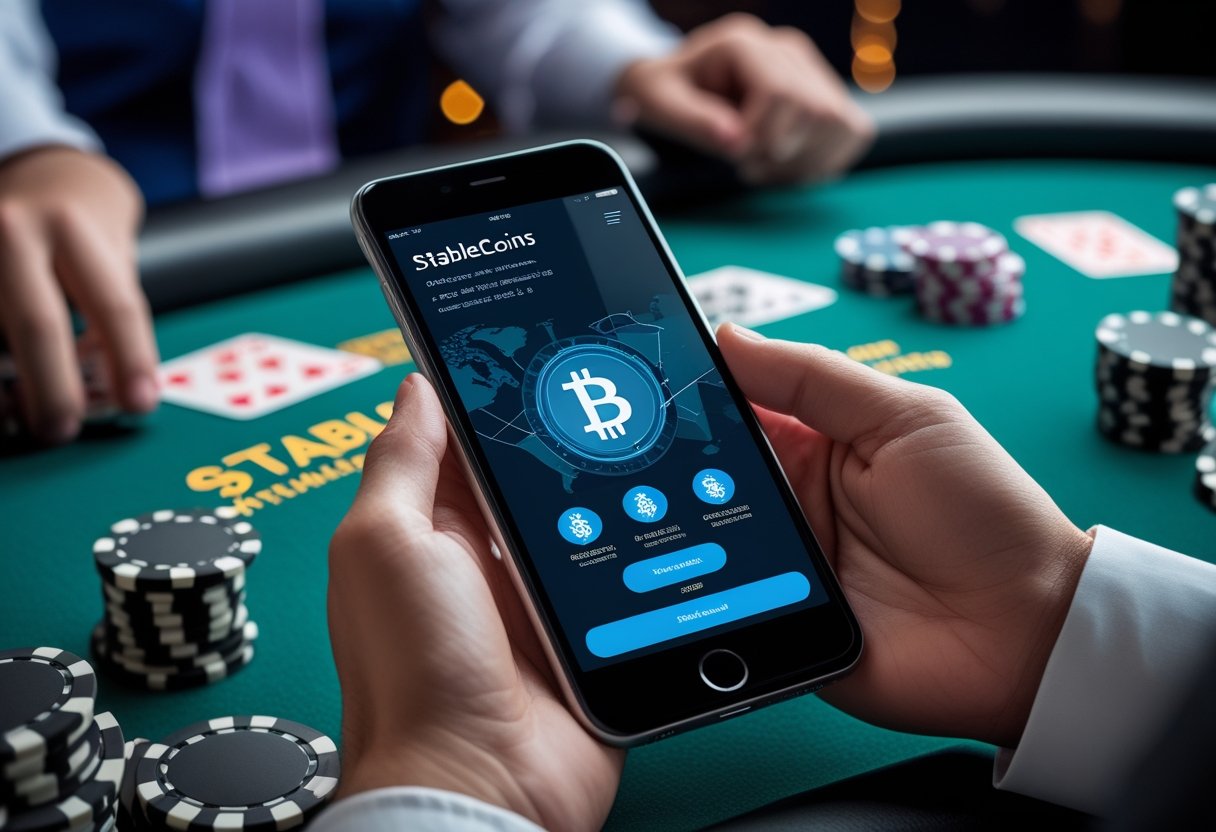
Why Use Stablecoins for Online Gambling?
Stablecoins offer gambling players a middle ground between traditional money and volatile cryptocurrencies. They deliver fast transactions and lower costs while maintaining a predictable value tied to established currencies like the US dollar.
Price Stability and Reduced Volatility
Stablecoins maintain a fixed value, typically pegged 1:1 to the US dollar. This means a player who deposits $100 in USDT will have $100 worth of betting power, unlike Bitcoin which can drop 10% in an hour.
The stability makes bankroll management straightforward. Players don’t need to worry about their balance shrinking before they place a bet. When someone wins $500, they can withdraw $500 worth of value, not an amount that fluctuates by the minute.
Popular stablecoins like USDT, USDC, and DAI are designed to hold their peg through various mechanisms. Some use cash reserves while others use algorithms. For gambling purposes, the result is the same: predictable value that works like traditional currency but moves like cryptocurrency.
This stability benefits both casual players and serious gamblers who need to calculate odds and manage funds precisely. The price predictability removes one major barrier that kept many people away from crypto gambling.
Lower Fees and Fast Transactions
Transaction costs for stablecoin gambling are significantly lower than traditional payment methods. Credit cards often charge 2-4% in processing fees. Wire transfers can cost $25-50 per transaction. Stablecoins typically cost a few dollars or less, depending on network congestion.
Speed is another major advantage. Traditional banking operates only during business hours, which represents just 23% of total hours. Stablecoins work 24/7/365 with no weekends or holidays.
Transaction comparison:
| Payment Method | Processing Time | Typical Fee |
|---|---|---|
| Wire Transfer | 1-5 business days | $25-$50 |
| Credit Card | 2-7 days for withdrawals | 2-4% |
| ACH | 3-5 business days | $0-$3 |
| Stablecoins | Seconds to minutes | $1-$5 |
Quick deposits and fast withdrawals happen because stablecoins settle on blockchain networks that never close. A player can deposit funds at 3 AM on Sunday and start playing immediately. Withdrawals process just as quickly, with most platforms releasing funds within minutes rather than days.
Privacy and Global Accessibility
Stablecoins provide more privacy than traditional banking methods. Players don’t need to share credit card numbers or extensive personal banking details with gambling sites. Transactions happen wallet-to-wallet using blockchain addresses.
Global access is built into stablecoin gambling from the start. Players from different countries can use the same digital currencies without currency conversion fees or international transfer restrictions. Someone in Brazil can deposit USDC just as easily as someone in Canada.
Many gambling platforms impose strict withdrawal limits when using traditional payment methods. Stablecoins often come with no withdrawal limits or much higher thresholds. This matters for high-stakes players who want to move large amounts quickly.
The borderless nature of digital currencies means players aren’t restricted by local banking infrastructure. Countries with limited banking access or strict capital controls can still participate in crypto gambling using stablecoins. The technology works the same regardless of geography.

Popular Stablecoins in Gambling Platforms
Three main stablecoins dominate the online gambling space: Tether (USDT), USD Coin (USDC), and DAI. These digital currencies maintain stable values by pegging to the US dollar, making them practical for casino transactions where players want to avoid the price swings common with Bitcoin or Ethereum.
Tether (USDT)
USDT stands as the most widely accepted stablecoin across gambling platforms. It launched in 2014 and maintains a 1:1 peg with the US dollar through reserves held by its issuer, Tether Limited.
Most crypto casinos support USDT across multiple blockchain networks. Players can use ERC-20 (Ethereum), TRC-20 (Tron), and BEP-20 (Binance Smart Chain) versions. The TRC-20 version is particularly popular for gambling because it offers faster transactions and lower fees than Ethereum-based transfers.
USDT represents more than half of all crypto gambling transactions in Europe. Platforms like BC.Game, Stake, and Lucky Block all accept it as a primary payment method. The stablecoin’s liquidity makes it easy to convert to other cryptocurrencies or withdraw to exchanges.
However, players should know that USDT operates through a centralized structure. Tether Limited controls the reserves, which has sparked debates about transparency in the crypto community.
USD Coin (USDC)
USDC serves as the second most common stablecoin in online gambling. Circle and Coinbase created it in 2018 with a focus on regulatory compliance and transparency.
The stablecoin publishes monthly attestation reports from major accounting firms. This transparency appeals to players who want assurance about reserve backing. USDC maintains its dollar peg through fully reserved assets held in regulated financial institutions.
Major gambling platforms including Stake, Cloudbet, and Betplay.io accept USDC deposits. It operates primarily on Ethereum but also runs on Solana, Algorand, and other networks. Transaction speeds vary based on the chosen blockchain.
USDC tends to have slightly less adoption than USDT in gambling markets. Yet it attracts players who prioritize regulatory oversight and transparent auditing. The stablecoin works well for high-volume bettors who need reliable value preservation.
DAI and Decentralized Alternatives
DAI offers a decentralized approach to stable value. MakerDAO created this algorithmic stablecoin, which maintains its dollar peg through smart contracts rather than centralized reserves.
Unlike USDT and USDC, no single company controls DAI. The stablecoin uses cryptocurrency collateral locked in smart contracts to maintain stability. Users can see all transactions and collateralization ratios on the Ethereum blockchain.
Platforms like BC.Game, Stake, and Cloudbet accept DAI for gambling transactions. Its decentralized nature appeals to players who value censorship resistance and transparency. However, DAI has less liquidity than USDT or USDC in gambling markets.
Other algorithmic stablecoins exist but see minimal adoption in gambling. Most platforms stick with proven options that offer deep liquidity. PAXG, a gold-backed stablecoin, appears on some crypto casinos but remains a niche option compared to dollar-pegged alternatives.
How Stablecoin Casinos and Betting Sites Operate
Stablecoin casinos accept digital currencies like USDT and USDC as payment methods for deposits, withdrawals, and wagering. These platforms combine the speed and accessibility of crypto with price stability that traditional cryptocurrencies lack.
Stablecoin Casino Deposits and Withdrawals
Players deposit stablecoins by sending tokens from their wallet to a unique casino address. The process typically takes minutes rather than days with traditional banking methods.
Most stablecoin casinos support multiple blockchain networks for deposits. Stake.com and BC.Game accept USDT and USDC on Ethereum, Tron, and Polygon networks. Players choose their preferred network based on transaction fees and speed.
Withdrawals work similarly. Players request a withdrawal to their wallet address, and the casino processes the transaction on-chain. Transaction fees for stablecoin deposits and withdrawals are significantly lower than credit card or wire transfer fees. Most platforms charge no deposit fees, though players pay network gas fees.
Verification requirements vary by platform. Some crypto casinos allow anonymous play with stablecoin deposits, while others require identity verification for larger withdrawals. These policies depend on the casino’s licensing jurisdiction and regulatory requirements.
Game Variety and Promotions
Stablecoin casinos offer the same game selection as traditional online casinos. Players find slots, table games like blackjack and roulette, live dealer games, and specialty games. The stablecoin serves as the betting currency rather than fiat money.
Many platforms offer exclusive bonuses for stablecoin users. These promotions include deposit matches, cashback rewards, and no-wager bonuses. BC.Game and similar platforms provide special tournaments for USDT players.
Smart contract technology enables provably fair games at stablecoin casinos. Players can verify game outcomes using blockchain data, ensuring the casino cannot manipulate results. This transparency represents a key advantage over traditional iGaming platforms.
Sports Betting and Prediction Markets
Stablecoin sports betting platforms operate globally without geographic restrictions of traditional bookmakers. Users wager on major sports leagues, esports competitions, and niche events using USDT or USDC.
Betting odds display in stablecoin units, eliminating currency conversion confusion. A $100 bet equals 100 USDT, making stake calculations straightforward for players.
Prediction markets built on blockchain technology allow stablecoin wagering on events beyond sports. Users bet on election outcomes, economic indicators, or entertainment awards. These decentralized platforms pool global liquidity through smart contracts, creating larger markets than region-specific betting sites could achieve alone.
Blockchains and Networks Supporting Stablecoin Gambling
Stablecoin gambling operates across multiple blockchain networks, each using different token standards like ERC-20, TRC-20, and BEP-20. These networks vary in speed, cost, and efficiency, which directly affects how players deposit and withdraw funds.
ERC-20, TRC-20, and BEP-20 Explained
ERC-20 is the token standard for stablecoins on the Ethereum blockchain. This standard allows USDT, USDC, and other stablecoins to work with thousands of decentralized applications. Most gambling platforms support ERC-20 tokens because of Ethereum’s widespread adoption.
TRC-20 operates on the Tron blockchain and offers faster transaction speeds than Ethereum. Tron processes transactions in seconds with minimal fees, making it popular for frequent deposits and withdrawals. Many gambling sites prefer TRC-20 USDT for its speed and low cost.
BEP-20 runs on Binance Smart Chain (BSC) and provides a middle ground between Ethereum and Tron. BSC combines relatively low fees with strong security and compatibility with many gambling platforms. Players can use BEP-20 stablecoins across numerous casinos and betting sites.
Each standard represents the same stablecoin but on different networks. A player holding USDT must choose which blockchain to use for their transaction.
Role of Ethereum, Tron, and Polygon
Ethereum serves as the foundation for most stablecoin activity in crypto gambling. The network processes billions of dollars in stablecoin transactions monthly and supports the largest selection of gambling platforms. However, Ethereum’s main network can experience congestion during peak usage.
Tron handles a significant portion of stablecoin gambling transactions due to its speed and efficiency. The network processes 3-7 times more transactions per second than Ethereum’s main layer. Gambling platforms often recommend Tron for players making multiple small deposits.
Polygon operates as a layer 2 solution that reduces Ethereum’s limitations. It provides faster confirmations and lower costs while maintaining connection to Ethereum’s security. Some gambling sites now offer Polygon as an option for players who want Ethereum compatibility without high fees.
These three networks dominate the stablecoin gambling space, with most platforms supporting at least two of them.
Gas Fees and Payment Methods
Gas fees represent the cost to process transactions on blockchain networks. Ethereum charges the highest gas fees, ranging from $1 to $50 depending on network congestion. These fees can make small gambling deposits impractical for casual players.
Tron maintains consistently low gas fees, typically under $1 per transaction. This makes it the preferred choice for players who deposit and withdraw frequently. The predictable fee structure helps gamblers calculate their actual costs.
BSC and Polygon offer mid-range fees between Ethereum and Tron. BSC transactions usually cost between $0.20 and $2, while Polygon fees stay under $0.50 in most cases. These networks attract players who want balance between cost and network security.
Payment methods vary by blockchain, but most gambling platforms accept direct wallet transfers. Players connect their crypto wallets and select their preferred network before completing deposits.
Risks, Limitations, and Best Practices in Stablecoin Gambling
Stablecoin gambling removes price volatility but introduces risks related to platform safety, legal uncertainty, and token selection. Players need to understand security practices, regulatory concerns, and how different stablecoins function in the crypto ecosystem.
Security and Platform Safety
Wallet security is the first line of defense when gambling with stablecoins. Players should use non-custodial wallets that give them full control over private keys. Hardware wallets provide the strongest protection for larger balances by keeping keys offline.
Common security mistakes include sharing seed phrases, sending funds to incorrect addresses, and storing wallet information online. These errors are permanent because blockchain transactions cannot be reversed.
Platform risk matters just as much as wallet security. Some casinos accept stablecoins but lack proper licensing or withdrawal history. Players should verify that casinos hold valid offshore licenses from jurisdictions like Curaçao or Panama. Test small withdrawals before depositing larger amounts.
Phishing attacks targeting stablecoin users are common. Scammers create fake casino sites or wallet interfaces to steal funds. Always verify website URLs and avoid clicking suspicious links. Using a VPN adds privacy protection and reduces tracking risks.
Regulatory and Legal Considerations
Stablecoin gambling exists in a gray area in many jurisdictions. Some regions restrict crypto gambling due to anti-money laundering concerns. Players should understand local laws before using stablecoins for betting.
Most stablecoin casinos operate offshore to avoid strict regulations in markets like the UK or US. These platforms use crypto-only deposits to bypass traditional banking restrictions. However, offshore licensing does not guarantee player protection.
Stablecoins face ongoing regulatory scrutiny because they bridge fiat currencies and the crypto ecosystem. Governments worry about their use in unregulated activities. Some stablecoins maintain transparency through regular audits and collateral disclosures. Others operate with less oversight.
Countries with developed gambling sectors often have stricter rules about payment methods. Stablecoin acceptance varies by region. Players in restricted markets may find fewer licensed options.
Choosing the Right Stablecoin for Gambling
USDT and USDC dominate stablecoin gambling because of wide casino support and strong liquidity. USDT works across the most platforms and offers the lowest fees on networks like Tron. USDC provides better transparency through regulated issuers and regular audits.
| Stablecoin | Best For | Network Options | Casino Support |
|---|---|---|---|
| USDT | Maximum compatibility | Ethereum, Tron, Polygon | Highest |
| USDC | Transparency and audits | Ethereum, Polygon, Solana | High |
| BUSD | Binance users | BNB Chain | Limited |
| DAI | Decentralized finance | Ethereum | Low |
USDT and USDC are backed by collateral held by centralized issuers. This introduces counterparty risk if the issuer faces financial or regulatory problems. DAI operates through smart contracts in decentralized finance but has less casino support.
Network choice affects transaction speed and cost. USDT on Tron offers fast, cheap transfers. Ethereum provides maximum compatibility but higher gas fees during peak times. Polygon balances low costs with good support.
Avoid unknown stablecoins with low market caps or unclear backing. Stick with established tokens that have proven reserves and transparent operations.
Frequently Asked Questions
Stablecoins are pegged to fixed assets like the US dollar and offer predictable value for casino deposits and withdrawals. These coins solve common gambling payment issues through stable pricing, lower fees, and faster transactions compared to traditional cryptocurrencies.
What are stablecoins and how do they benefit online gambling?
Stablecoins are cryptocurrencies designed to maintain a fixed value, typically pegged to one US dollar. Each coin equals one dollar, which makes them ideal for casino payments.
The main benefit is stability. A player’s bankroll does not change in value during games or betting sessions. This removes the price risk that comes with Bitcoin or Ethereum gambling.
Stablecoins also offer faster withdrawals. Payments move directly from wallet to wallet without bank approval. Most payouts complete within minutes rather than days.
Transaction costs are lower with stablecoins. Players avoid credit card processing fees and international transfer charges. The blockchain handles settlement with minimal costs.
How do stablecoins maintain their value in the context of gambling platforms?
Most stablecoins use a fiat peg backed by dollar reserves. The issuing company holds one dollar in reserves for every stablecoin in circulation.
This reserve system keeps the price stable even when crypto markets fluctuate. The coin stays at one dollar regardless of what happens to Bitcoin or Ethereum prices.
USDT and USDC maintain their value through regular audits and transparent reserve reporting. These practices help ensure the peg remains reliable during gambling sessions.
The gambling platform does not control the stablecoin’s value. The value is maintained by the issuer through the reserve backing system. Casinos simply accept the coins as payment.
What are the advantages of using stablecoins over traditional cryptocurrencies in gambling?
Stablecoins eliminate volatility. Bitcoin and Ethereum can change in value while a player is actively gambling. Stablecoins keep the balance predictable from deposit to withdrawal.
Lower fees are common with stablecoins. Bitcoin can have high transaction costs during network congestion. Ethereum gas fees spike during peak usage. Stablecoins on networks like Tron or Polygon often cost less to transfer.
Bankroll management becomes simpler. Players can plan their gambling budget without worrying about market swings. A 100 USDT deposit stays worth 100 dollars throughout the entire session.
Withdrawals reflect actual winnings. With Bitcoin, a player might win a bet but lose value due to price drops. Stablecoins ensure that winnings maintain their dollar value when cashed out.
Can you recommend secure wallets for holding stablecoins used in gambling activities?
Non-custodial wallets give players full control over their funds. The wallet owner holds the private keys rather than a third party. Popular options include Metamask, Trust Wallet, and Exodus.
Hardware wallets provide the highest security level. Devices like Ledger or Trezor store private keys offline. These wallets work well for players who hold larger balances or frequent winnings.
Mobile wallets offer convenience for regular betting. Trust Wallet and Exodus support multiple stablecoins and work across different blockchain networks. These options balance security with ease of use.
Players should verify network compatibility. USDT and USDC work on multiple blockchains including Ethereum, Tron, and Polygon. The wallet needs to support the specific network the casino uses.
What are the best practices for managing stablecoins within gambling applications?
Never share seed phrases or private keys. These credentials provide complete access to wallet funds. Legitimate casinos never ask for this information.
Start with small deposits and test withdrawals first. This confirms the casino processes payouts properly before sending larger amounts. A successful test withdrawal indicates reliable platform operations.
Double check wallet addresses before sending funds. Blockchain transactions are irreversible once confirmed. One wrong character in an address means permanent loss of funds.
Keep most funds in a secure wallet rather than casino accounts. Only deposit what is needed for active gambling sessions. Move winnings back to a personal wallet regularly.
Use different networks to control transaction costs. TRC-20 USDT on Tron typically has lower fees than ERC-20 on Ethereum. The casino deposit page shows which networks are supported.
How do different types of stablecoins, such as fiat-collateralized or crypto-collateralized, impact gambling transactions?
Fiat-collateralized stablecoins like USDT and USDC are backed by dollar reserves held by the issuer. These coins are the most common in gambling because they offer simple value stability and wide casino acceptance.
Crypto-collateralized stablecoins use other cryptocurrencies as backing. DAI is the most common example. These coins are less popular in gambling due to more complex mechanisms and fewer casino integrations.
Fiat-backed stablecoins process faster and cost less in most gambling scenarios. The value stays consistent and the coins are widely supported across casino platforms. They work on multiple blockchain networks with low transaction fees.
Crypto-backed stablecoins involve more technical complexity. The value can be slightly less stable due to the collateral structure. Most gambling platforms focus on fiat-backed options for simplicity and reliability.
Casino operators prefer USDT and USDC because they have proven track records and strong liquidity. Players benefit from the predictability and ease of converting these coins to and from fiat currency. Other stablecoin types remain less common in gambling applications.